

Normal Pressure or Lost Momentum? Signs a System Project Is Drifting
Normal pressure or lost momentum? The signals to check before your next steering committee
Every systems project feels hard in the middle. The question a sponsor needs answered is whether it's the normal pressure of big change, or whether the project is losing momentum.
From the steering committee, the two can often look the same. The report says amber, trending green. The vendor says the next release will sort it. And yet, the people closest to the work are saying something different, in the corridors and after the meeting.
Here's how to tell the difference, and what to ask before your next checkpoint.
The short answer
Normal pressure has a cause you can name and a point where you're expecting it to ease or shift. Lost momentum shows up as the same issues staying open while the dates hold and the reasons for missing them keep evolving.
If you can say what's causing the strain and when you think it will ease, you're probably dealing with pressure. If you can't, or the answer has changed three times, it's time to look deeper.
Why the status report won't tell you
Status reports show progress against a plan. When the plan moves, the report moves with it. Everyone knows that a red project timeline can move to green with the approval of one change request. The Victorian Auditor-General saw this in a 2016 review of government ICT projects: "Once time lines are re-baselined, the project status turns from 'delayed' (red) to 'on track' (green)." The baseline changes and the colour follows.
There's more to it than simply following a colour on the executive summary. In 2014, Keil, Smith, Iacovou and Thompson drew on 14 earlier studies of project status reporting for MIT Sloan Management Review: a summary of their work notes that people "put a positive spin" on what they report to senior management, mainly because they're on the weaker side of the power relationship.
I wouldn't call that deliberate dishonesty, but in lived experience, it is how most organisations and power dynamics work.
The same researchers make the point that matters most for sponsors: complex IT projects "do not fail overnight; they fail one day at a time, and generally only after numerous warning signs." The warning signs are usually there. They just aren't necessarily in the report, or if they are they are carefully worded to not flag alarm.
So another status meeting, or a more detailed report, rarely tells you what you need to know. You need to look somewhere else.
Where to look: three undercurrents
At 6R we look at three things running under the surface of a project: Alignment, Action and Accountability. When momentum drains away, it usually starts in one of them.
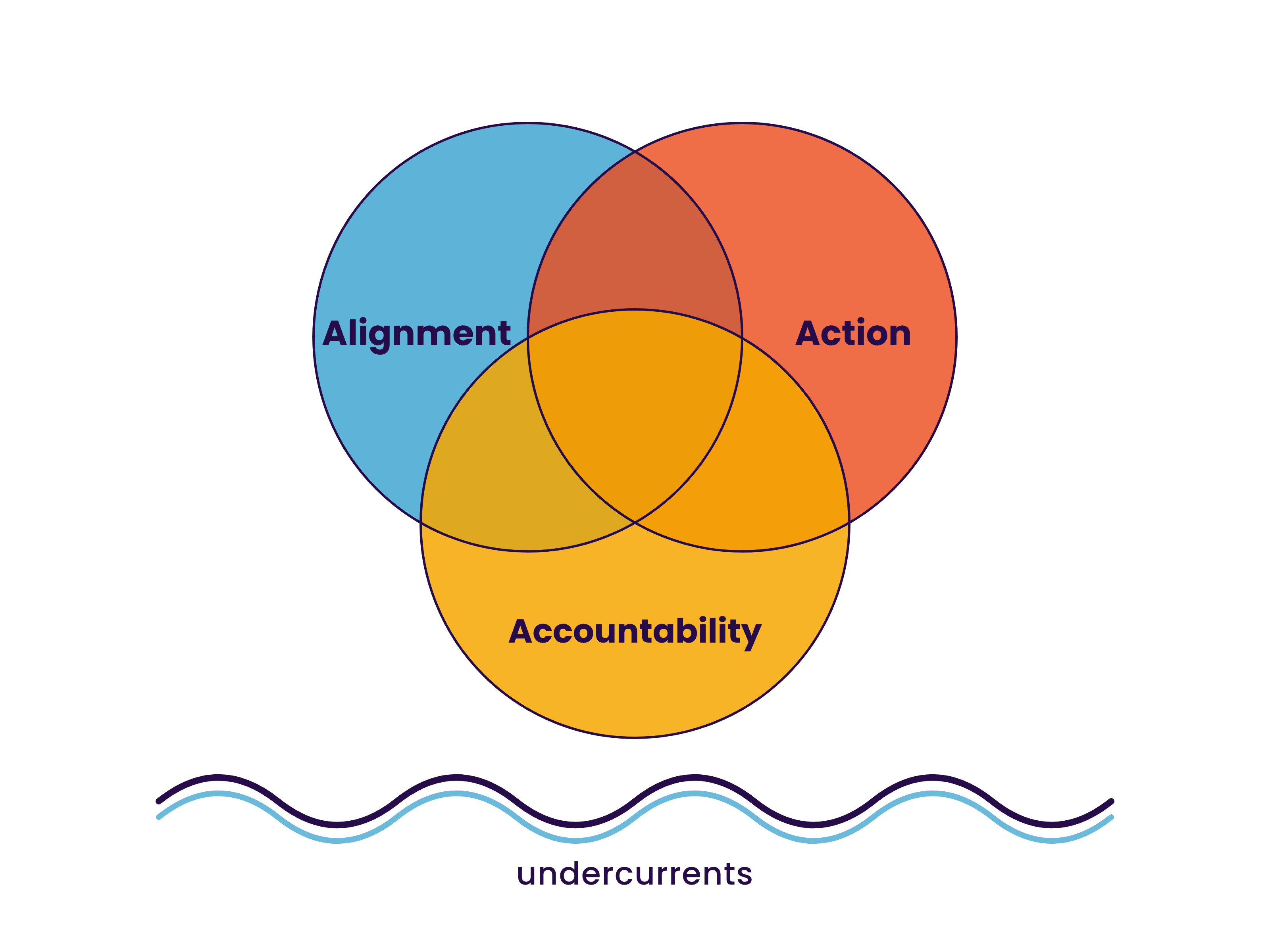
1. Alignment: agreement, but not really
- People nod in the meeting and reopen the decision in the hallway.
- Leaders describe the purpose and importance of the project in different ways.
- The scope is "agreed", but each team carries its own version of what's in or what that means.
The question to ask: if five leaders each wrote down what this project must deliver to be worth it, would you get answers that were materially consistent?
2. Action: plenty of planning, not enough meaningful movement
- The same items carry over from meeting to meeting.
- Decisions wait for one more workshop, one more round of analysis or one more person.
- Risks sit on the log for weeks without anything changing or being closed out.
- Milestones consistently get re-planned or moved around rather than met.
The question to ask: how long did your last three significant decisions take from being raised to being made?
3. Accountability: it's not clear who owns what
- Decisions get made, but nobody follows them through.
- Issues bounce between the business, the vendor and IT.
- Business people are named on the plan but aren't free to do the work.
- Sponsors are nominated but don't support the work getting done.
The question to ask: for the three most important open issues, can you name the one person who owns each, and what they're waiting on?
One or two of these signals on their own is normal on any big project. Several, across more than one stream of work, sitting there for weeks, is a pattern.
The signal that looks like good news
Watch for the project that has gone quiet. Meetings that finish early. Nobody pushes back. The report is calm.
Sometimes, that's real progress.
Sometimes, it means people have stopped challenging because challenging hasn't changed anything. Things look calm because the hard conversations have moved out of the room.
A quiet project with a long list of carried-over actions isn't necessarily a calm project. It's a project where the bad news has nowhere to go.
Urgency can hide drift
Timeline pressure is meant to keep a project moving, but, it can also do the opposite.
When the date leads, people make compromises in its name. They work at headline level instead of getting into the detail, and they make bigger assumptions, sometimes without naming them. Just because one part of an integration or system is working doesn't mean the whole thing is.
I've watched teams get a system over the line on adrenaline, keen to show progress, and then spend the months after go-live finding out what was hiding in some of the unseen assumptions. Reporting that's missing. Responsibilities nobody agreed to. Questions about who maintains what, which should have been answered earlier.
The project looked like it had momentum. What it had was speed.
What normal pressure looks like
Hard projects are meant to feel hard. Normal pressure usually looks like this:
- The problem has a name, an owner and a plan.
- Bad news arrives early enough to do something about it.
- Decisions get made, even unpopular ones, and even if not everyone agrees they stick.
- The team is tired but can tell you exactly what's in the way.
- Timeline pressure exists and the team know what they need to give up or who they need help from to deliver.
That's a project that is hard, not stuck. It needs support and protection, not a rethink.
Three questions to consider in the next steering committee
1. Which decision, if we made it this week, would create the most capacity?
2. Which risks have been on the log for more than a month? What's changed about them?
3. If we didn't have the current go-live date, what would we say this project needs?
Ask them openly, and listen to the pauses as much as the answers.
Common questions
1. What are the warning signs that a system project is losing momentum?
The same actions carrying over from meeting to meeting, decisions waiting on one more workshop, risks that sit unchanged for weeks, and milestones that get re-planned rather than met. One sign on its own is normal. Several across alignment, action and accountability is a pattern.
2. Why does my status report say green when the team is worried?
Reports track progress against the current plan, so re-baselining can turn red into green without the project changing. People also tend to report upward more positively than they speak among themselves. Look at decisions, carried-over actions and open risks instead of the colour.
3. Is it normal for an ERP or system project to feel stuck in the middle?
Feeling hard is normal. Being stuck isn't. If you can name the cause of the strain, who owns it and when it will ease, it's pressure. If you can't, look more closely.
What one reset day surfaced
The most recent reset day I ran wasn't prompted by a missed milestone. An internal restructure had affected the project team, and the sponsor wanted to know where the project really stood.
Two things came out of that day that no status report had shown.
The first was that the CEO and the COO didn't agree on the priority of the project. When we asked what the most important project was this quarter, the CEO said it was critical. The COO said it wasn't in the top three.
The second was that the project needed an extra month.
Neither finding was dramatic. Both had been sitting under the surface. And both are far easier to deal with around a table than in testing or at cutover.
If several of these are true
Then it's worth stepping back before pressing on. That doesn't necessarily mean going back to the original plan. It means establishing what's true now, whether the outcome still matters, and what path is credible with the decisions, people and capacity you actually have.
That's what a Reset Day is for. If you're recognising more than a few of these signals in your own project, book a Reset Day conversation. We'll talk through what you're seeing, and whether a reset is the right next step or you're dealing with normal pressure that needs holding steady.
Later this month, I'm releasing a short diagnostic that helps you see which undercurrent is running in your project. Watch for it in the newsletter.
Retail improvement, made practical.
Leadership thinking that drives change.
Sign up to receive new articles and strategic guidance.


