

System Replacement in Retail: When Working Systems Get Ripped Out
When a new leader inherits a system, the strongest incentive may be to make a visible change, rather than making the best decision.
A retail business I know spent the best part of a year and hundreds of thousands of dollars building a customer data platform. There was no launch spectacle, no executive roadshow. Just the slow, unglamorous work of resolving data issues, aligning systems, and getting users confident enough to make it operate.
It went live. And it worked.
Then the business changed leaders. The incoming leader looked at the platform, decided they didn't like it and pulled the pin. No independent review of the business case. No test of whether the problem was the platform or its adoption. The vendor exited, the work was dismantled, and most of the team left, taking the operational knowledge with them.
Calling this an ego problem is too easy. Rather, I think of it as the 'Pressure Paradox'. The situation where being seen to act can carry more organisational reward than getting it right.
Why new leaders change the systems they inherit
CEO succession research shows incoming leaders frequently reverse predecessors' decisions, including profitable ones, independent of whether those decisions were sound.
A 2018 study by Hutzschenreuter, Kleindienst, and Greger found that successors are more likely to divest a predecessor's investments when the successor closely resembles the predecessor. If a new leader looks like a continuation of the old regime, a visible break often becomes a way to prove otherwise.
A 2023 study of 4,128 Chinese listed-company observations found that outside successors were more likely than insiders to initiate strategic change, and that outsider-led change actually weakened the usual link between strategic change and firm value. Leadership transition makes action more likely well before the business has evidence that action is the right call.
The inherited-system trap: when system replacement becomes the default
The original sponsor can fall into what academics call ‘escalation of commitment’. Continuing to defend a struggling system because admitting it was wrong feels like admitting they were wrong. A successor has the opposite problem.
They carry no responsibility for the original decision, so system replacement costs them nothing personally and hands them a clean leadership narrative.
Chulkov and Barron's 2021 research on CEO departures argues that leaders often have an incentive to conceal earlier decision errors by continuing to fund them. A change in the decision-maker can interrupt this pattern.
Put the two effects together, and a project governance blind spot appears:
the person who made the decision over-defends it, and
the person who inherits it under-defends it.
Neither reaction is measuring the system's actual quality.
The loop that makes system replacement feel inevitable
A system goes live with incomplete adoption or unresolved process design.
The business sees underwhelming value and concludes the system is not doing what it should. A leadership change creates pressure for a visible break from the past. System replacement becomes easier to explain than disciplined remediation.
The replacement programme starts with the same unresolved process and ownership problems. Value arrives slowly again, setting up the next leader for another visible break.
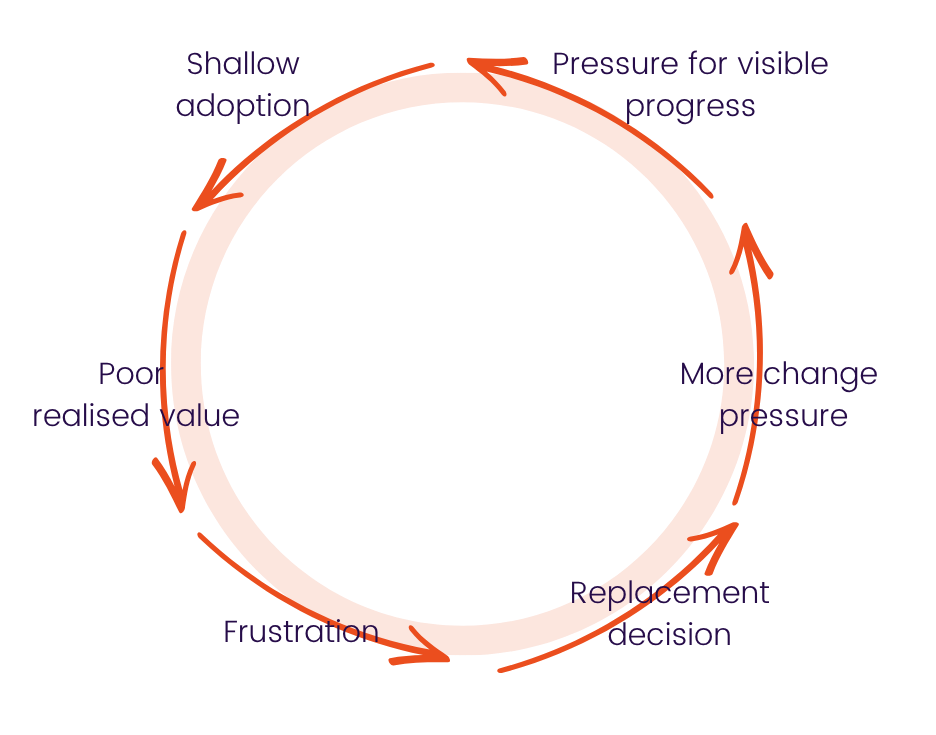
The problem here is in the decision architecture: action is rewarded before establishing the impact of the underlying problem.
In retail, an ecommerce platform, an ERP implementation or a CRM system can look like it's failing when the constraints could also be poor master data, fragmented integration ownership, manual workarounds, or a business case whose benefits were assumed rather than articulated. What appear to be ERP implementation challenges may therefore sit outside the technology itself.
The same applies when assessing ERP failures. A system can appear to have failed when the underlying issue is process design, ownership, data quality, or adoption.
Replacing the technology doesn't remove any of those constraints by itself. The same is true where CRM system integration is affected by fragmented ownership or manual workarounds.
Why system replacement is not always the answer
Some systems genuinely no longer serve the business. Perhaps they were built for a strategy that no longer exists, or cost more to fix than to replace.
The evidence doesn't support blanket retention any more than it supports blanket system replacement. A radical break also carries its own cost: new leaders must overwrite inherited routines and relationships, and a replacement can just as easily create team alignment or knowledge loss problems as it solves a technology one.
This is part of the wider challenge of retail transformation: changing technology does not automatically resolve the organisational conditions around it.
Building a better decision architecture through project governance
The goal is to protect the business from both biases at once: the incumbent's tendency to defend what they built and the successor's incentive to demonstrate a break.
1. Set evaluation criteria before the verdict
Agree on what "working" means in operational terms before deciding whether a system stays or goes: are core processes completed without manual workarounds, what percentage of transactions meet agreed data standards, and which original business-case benefits are realised, partly realised, or blocked. Agree on these with the sponsor, operational owners, and technical leads before a decision becomes politically attractive.
2. Separate evaluation from credit
The person reviewing an inherited system should not be the one whose leadership narrative depends on replacing it, or the original sponsor whose reputation depends on defending it. Just as we have separation of duties when it comes to spending money, so too in assessing systems.
3. Make remediation compete fairly with replacement
Replacement business cases are usually detailed; remediation cases are often vague: "improve adoption", "fix the data". Give both the same commercial discipline: cost to complete, time to measurable value, disruption, dependency risk, and clear exit criteria. If remediation can't win under that discipline, replace. If a replacement can't show how it removes the underlying constraint, it isn't a solution.
4. Protect organisational memory
Before switching platforms, capture the process decisions the system embodies, known defects, integration maps, data rules, and the workarounds users rely on. Otherwise, the business rebuilds the same problems in a new system.
The leadership test for system replacement decisions
The pressure for visible progress will not disappear. A new executive is expected to make a mark; a board wants confidence that performance will improve. But a replacement decision should survive one question:
Are we replacing this system because evidence shows it cannot support the business we need to become?
That question protects against the sponsor who keeps funding a failing platform rather than admitting the original call was wrong, and against the incoming leader who discards a working one because being seen to act carries more reward than being right.
A good system may still need to go. A new leader may be exactly what the business needs. But the decision should be earned with evidence, not made necessary by the pressure to tell a better story.
Retail improvement, made practical.
Leadership thinking that drives change.
Sign up to receive new articles and strategic guidance.


