
Why Projects Fail: The Momentum Ladder for Team Alignment
Your Project’s Momentum Problem Isn’t What You Think
Right now, somewhere in your organisation, a project team is either building momentum or bleeding it.
And the difference between those two states is not your methodology, your meeting cadence, your governance framework, or even the latest productivity tools. It’s where your team sits on what I call the Momentum Ladder.
Most project leaders look at a team that’s grinding and think: we need better process, better agile methodology, better project planning templates, or a tighter project charter template.
That’s the wrong diagnosis. Process is the symptom. What’s underneath is almost always a clarity problem, an expectation problem, or a culture problem.
Many common project management challenges don’t begin with structure. They begin with alignment.
What Most Project Leaders Get Wrong?
The triple constraints, scope, time, cost, are real. But they’re not the primary driver of whether a project builds energy or loses it, or why projects fail.
The Momentum Ladder maps teams across three dimensions: activity (what you're actually doing), focus (where attention is going), and momentum (the speed and direction of progress).
Two failure zones sit below the waterline, three performance zones above it. When team alignment is weak, momentum stalls regardless of how refined the governance appears.
A Harvard Business Review study confirms that just 3–5% of people contribute approximately 30% of the cross-functional momentum on a project. We often call these people the extra milers.
They are deeply aligned with the project's purpose. They don’t need convincing. They amplify everyone around them. This is leadership alignment in action, not hierarchy.
The implication? You don’t need the whole organisation committed before you start. Research on minority influence shows it takes only about 10% of a group with unshakeable belief to shift the rest, and roughly 25% of a workforce to commit to a change to create momentum across an entire business.
The lever isn’t mass buy-in. It’s targeted alignment to purpose. This is where many change management challenges either resolve or intensify.
"You don't need everyone converted. You need the right people clear."
The Hidden Mechanism at Each Rung
This is what the status report doesn’t show you.
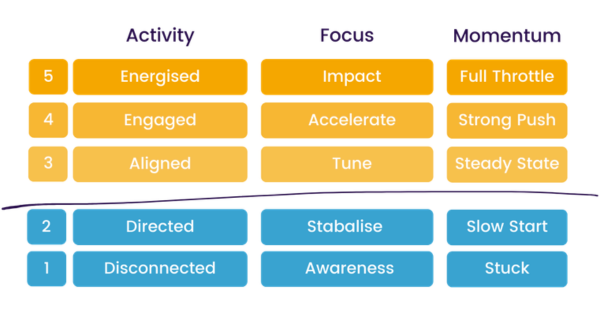
Level 1 – Disconnected (Stuck)
The surface problem looks like low motivation, team misalignment, or absent process. The real problem is almost always an absence of shared purpose, or purposes at cross purpose. People can’t move toward something they can’t articulate.
Without clarity of purpose, even your most capable team members feel disconnected. Not necessarily because they’re checked out, but because they genuinely don’t know why it matters.
Prosci’s ADKAR model places Awareness as the first building block for exactly this reason: you cannot create Desire without it. This is one of the overlooked reasons why projects fail long before execution pressure appears.
Level 2 – Directed (Slow Start)
Teams here are receiving direction and momentum is being generated, but slowly, the wheel is beginning to turn.
The hidden trap here is often our deeply human tendency to believe we can complete work faster than is realistic. The Sydney Opera House was scoped at $7 million over 4 years. It cost $102 million and took 14.
The lesson isn’t that project teams are incompetent. It’s that stabilising takes longer than anyone typically wants to admit and managing that expectation is a leadership function, not a planning function.
Leaders often attempt to accelerate this phase with sample project charter documents, tighter reporting, or comparing a program manager vs project manager role structure. Yet without alignment, these levers rarely solve the underlying friction.
Level 3 – Aligned (Steady State)
Teams are gelling, roles are clearer, and trust is forming. The flywheel is moving. This is where team alignment becomes visible in behaviour, not just intention.
At this level, we’re looking to bring both safety and stretch into play. Amy Edmondson’s research on psychological safety at work is unambiguous: teams need safety to contribute ideas and need a stretch goal to develop. Without both, you get either comfortable mediocrity or fearful compliance.
For leaders asking how to create psychological safety at work, the answer begins with clarity of standards and clarity of purpose. Legislators are paying attention, with psychosocial safety increasingly in focus in Australian workplaces.
This is not a soft concept. It is a structural condition for sustainable performance and a practical response to ongoing project management challenges.
Levels 4 & 5 – Engaged and Energised (Strong Push / Full Throttle)
Here, teams become proactive, anticipate needs, and solve problems collaboratively without waiting for instruction.
At Level 5, researchers describe what’s known as team flow, where collaboration feels genuinely effortless. This reflects the forming performing evolution of team maturity.
But the risk at this altitude is burn-out. Engaged teams give discretionary effort that, if unrecognised or unmanaged, becomes unsustainable.
The assumption that a high-performing team can maintain peak output indefinitely is the dark side of success.
Prosci’s reinforcement principle addresses exactly this: without recognition and sustainment mechanisms, even the best adoption erodes when the next priority lands. Sustainable momentum requires ongoing project improvement ideas, not just early energy.
"The dark side of high performance is assuming the engine runs indefinitely without fuel."
Your 3-Step Sanity Check
You can run this in a team session in under fifteen minutes. Ask one question per dimension, name the rung honestly, then choose one lever.
Activity check: Are people waiting for direction or proactively solving problems? Waiting means directed or below. Anticipating needs means engaged or higher.
Focus check: What does the team talk about in meetings? “Who’s responsible” signals early stabilisation. “How do we stabilise this” reflects directed effort. “How do we accelerate” indicates emerging momentum.
Momentum check: How does progress feel? Stuck, slow, steady, accelerating, full speed?
Then name it: “I think we’re directed right now, stabilising roles and process. Do you agree?” Shared language creates shared understanding.
These conversations often surface deeper insights into how to improve employee productivity than any standalone productivity tools ever will.”
The Permission You Might Need
This ladder isn’t a straight line. A sponsor goes quiet, scope shifts, a key person leaves, and suddenly, a Level 4 team is scrambling to stabilise at Level 2. That is not failure. It is a response to changing circumstances.
Many so-called project recovery efforts focus only on documentation or control. True recovery begins with re-establishing purpose and leadership alignment before reintroducing structure. That is how you address the deeper reasons why projects fail.
The flywheel analogy, which Jim Collins introduced in Good to Great, makes this visible. Getting it moving requires consistent, sustained effort, not heroic one-off bursts.
The Japanese concept of Kaizen, continuous incremental improvement, matters here: small, consistent changes compound over time, in projects just as in any other system.
When the team slides back, it’s not defeat. Look for what changed, what support is needed, and treat the backslide as information.
As Edmondson’s research shows, psychological safety at work combined with high standards creates learning cultures. The Momentum Ladder isn’t a weapon for shaming underperformance. It’s intended as a mirror and a map.
Retail improvement, made practical.
Leadership thinking that drives change.
Sign up to receive new articles and strategic guidance.


